

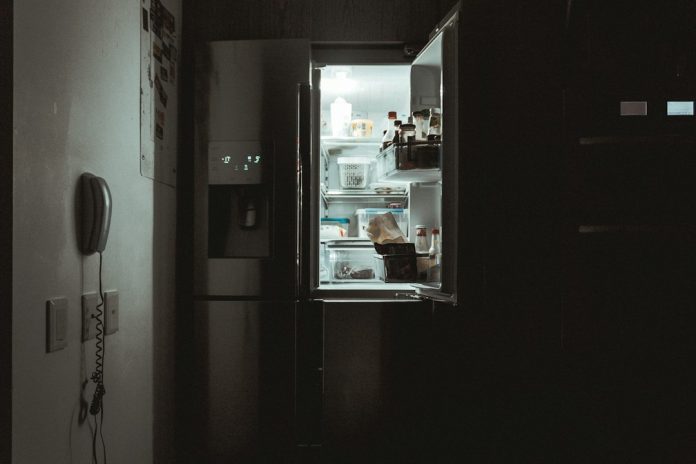
A power outage turns the refrigerator into a countdown. The safest response is not to keep opening the door to check the food, and it is not to rely on smell or appearance. It is to track time, preserve the cold and make conservative decisions once power returns.
Federal food-safety guidance says an unopened refrigerator keeps food safely cold for about four hours. A full freezer can hold its temperature for roughly 48 hours, while a half-full freezer is closer to 24 hours, provided the door stays closed. Those time windows are planning guides, not guarantees for every appliance or room temperature.
Start the clock and keep the doors closed
Note when the electricity failed. If the outage began while you were asleep or away, use the most conservative plausible start time. Avoid repeated door opening: every check releases cold air and shortens the useful window.
Move a refrigerator or freezer thermometer where it can be read quickly. Food kept at 40°F (4°C) or below remains within the usual refrigeration safety range. If you have frozen gel packs or a cooler and the outage is expected to last, prepare them before the four-hour mark rather than waiting until the refrigerator has warmed.
Know which foods deserve priority
Perishable refrigerated foods need the most caution. This group includes meat, poultry, seafood, eggs, milk, soft cheeses, cooked leftovers and many cut fruits or vegetables. After four hours without power, refrigerated perishable food should be discarded unless you can verify it remained at 40°F (4°C) or below.
Some items are more tolerant, including many whole fruits and vegetables, hard cheeses, butter, unopened shelf-stable products and certain condiments. Use an official food-safety chart for item-by-item decisions; do not assume that every product stored in the refrigerator has the same risk.
Never use taste as a test
Food that can cause illness may look, smell and taste normal. Do not sample questionable food to decide whether it is safe. When the time or temperature history is uncertain, discarding the item is the lower-risk choice.
The same caution applies to food affected by flooding. Food or drink that contacted floodwater needs a separate assessment, and many packages that appear sealed are not designed to be safely cleaned after contamination.
Handle the freezer separately
Frozen food that still contains ice crystals or has stayed at 40°F (4°C) or below can often be refrozen or cooked, although quality may decline. A tightly packed freezer preserves cold longer than a partly filled one. Grouping items together before an expected outage can help them stay cold, as long as you minimize door opening.
If you use dry ice, follow supplier instructions, provide ventilation and protect skin from direct contact. Never handle dry ice with bare hands or use it in a way that allows carbon dioxide to accumulate in an enclosed living space.
A safer reset when power returns
- Record the total outage duration.
- Check appliance thermometers before moving food.
- Separate foods that stayed within the safe temperature range from those with uncertain history.
- Discard perishable refrigerated food that exceeded the four-hour guidance or warmed above 40°F (4°C) for too long.
- Clean leaks promptly and wash hands after handling discarded food.
- Restock gradually so the appliance can return to a stable temperature.
Prepare before the next outage
Keep an inexpensive thermometer in both the refrigerator and freezer. Freeze containers of water to help fill empty freezer space, leaving room for expansion. Store gel packs, label leftovers with dates and maintain a small shelf-stable emergency food supply that does not require cooking or refrigeration.
People at higher risk of severe foodborne illness—including pregnant people, adults over 65, young children and people with weakened immune systems—should use especially conservative decisions.
Bottom line: keep the doors closed, track time and temperature, and do not use taste or smell as a safety test. If the history is uncertain, throw it out.
This article provides general food-safety information and does not replace local emergency instructions. Sources: USDA Food Safety and Inspection Service and FoodSafety.gov.














