The World Health Organization and the Australian National University have launched a collaborating centre focused on health-security workforce development and research. Based at ANU’s National Centre for Epidemiology and Population Health, the centre is intended to strengthen field epidemiology, outbreak response and the evidence used to organize emergency teams across the Western Pacific.
The designation recognizes a partnership built over more than three decades. It also responds to a practical weakness identified in recent country assessments: emergency plans depend on trained people who can detect a threat, investigate it, interpret rapidly changing data and translate findings into action.
What a WHO collaborating centre does
A WHO collaborating centre is an institution designated to support the organization’s programmes through agreed technical work. It is not a new WHO regional office and it does not replace national public-health agencies. Its role is to contribute expertise, training, research and professional networks to priorities defined with WHO and its Member States.
Australia hosts more than 50 such centres, the highest number per capita globally according to WHO. The new ANU centre adds a specialized focus on the workforce needed for health emergencies.
Field epidemiology turns data into action
Field epidemiologists work at the point where surveillance meets operations. During an outbreak they help define cases, organize data collection, identify patterns, assess possible transmission routes and advise response teams. Their work has to be technically sound, but it also has to be fast enough to inform real decisions.
ANU’s Australian Field Epidemiology Training Program has operated since 1991. More than 300 graduates of its Master of Philosophy in Applied Epidemiology now work in senior public-health roles in Australia and internationally. The programme has included fellows from Pacific and Southeast Asian countries, and 14 trainees have contributed to WHO’s Regional Health Emergency Corps initiative.
The gaps are not only about headcount
Between 2023 and 2026, thirteen Western Pacific countries assessed their health-security capacities through Joint External Evaluations. WHO reports persistent workforce problems, including fragmented training, unequal access to professional development and limited funding.
Those gaps can affect every stage of a response. A country may have surveillance software and laboratory capacity but still struggle if there are not enough people trained to investigate signals, coordinate across agencies or sustain operations during a prolonged emergency.
Workforce strength also depends on how teams function. Research is needed on deployment, leadership, role clarity, communication, fatigue, retention and the transition from an emergency surge back to routine services.
Training and applied research will work together
The new centre will support training for the next generation of field epidemiologists while also studying how outbreak-response teams are deployed and how their performance can improve. That combination matters because a curriculum should be informed by the realities teams encounter in the field.
Applied research can identify which team structures work under different conditions, where delays occur and what kinds of support help trained professionals remain effective. Evidence from one country cannot always be transferred unchanged to another, so regional collaboration and local adaptation are both necessary.
A role in equitable scientific publishing
The centre will also support the Western Pacific Surveillance and Response journal. WHO describes this work as part of an effort to make scientific publishing more equitable across the region.
Outbreak evidence is often produced by local teams operating under pressure. Helping those teams analyze and publish their findings can improve the regional knowledge base, make lessons easier to share and ensure that professionals closest to an event receive appropriate authorship and visibility.
What success should look like
The centre’s impact will not be measured by designation alone. Useful indicators include the number and distribution of trained professionals, the quality and speed of investigations, the retention of graduates in public-health roles, the performance of deployed teams and the extent to which research changes practice.
Long-term funding and national ownership will remain essential. A collaborating centre can expand training and evidence, but countries still need career paths, operational budgets and institutions able to use that expertise between emergencies.
A stronger network before the next emergency
Health emergencies rarely respect borders, and no single institution can maintain every capability on its own. The new WHO–ANU centre is designed to strengthen a regional network before the next major event, when the time available for training and relationship-building will be much shorter.
Its central proposition is straightforward: preparedness is not only a stockpile, a plan or a surveillance platform. It is also a workforce with the skills, authority and connections to act on evidence when conditions change.
Primary source: World Health Organization news release.
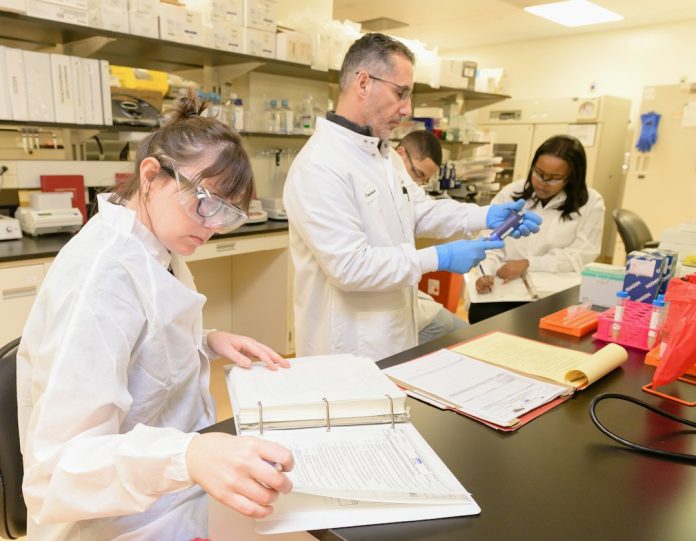
Featured image: public-health training photograph by the National Institute of Allergy and Infectious Diseases via Unsplash. It is illustrative and does not depict the WHO–ANU centre.