The World Health Organization has launched a global movement designed to strengthen trust in science and improve the way evidence reaches health policy and everyday decisions. The initiative, called Together for Science and Health, begins with more than 240 participating organizations and three connected priorities: science and society, science and policy, and science communication.
The launch is not a new clinical guideline, treatment recommendation or public-health mandate. It is a collaboration framework. Its value will depend on whether participating institutions turn broad commitments into practical ways of listening, explaining uncertainty and using evidence transparently.
Why trust is an operational health issue
Scientific evidence does not improve health automatically. A discovery has to move through evaluation, policy, professional practice and public understanding before it changes an outcome. Trust influences every step.
People need confidence that evidence has been produced rigorously, that important uncertainties are disclosed and that recommendations can change when better information becomes available. Health professionals need access to usable guidance. Policy-makers need methods that distinguish strong evidence from early signals or advocacy.
When those links fail, even accurate information may not translate into action. The result can be delayed vaccination, poor adherence to effective treatment, confusion during outbreaks or public debate that treats scientific revision as proof of bad faith rather than a normal part of inquiry.
Three pillars, different responsibilities
WHO organizes the movement around three areas of collaboration.
Science and society focuses on bringing researchers and communities closer together. That includes asking whether research questions reflect people’s needs, whether affected groups can help shape the work and whether the benefits of scientific progress are shared fairly.
Science and policy focuses on the path from evidence to decisions. Good policy does not require perfect certainty, which is often unavailable. It requires clarity about what is known, what remains uncertain, which populations were studied and what trade-offs a decision creates.
Science communication focuses on how evidence is developed, discussed and understood. Communication is not simply the final step after experts agree. Questions from patients, families and communities can reveal where an explanation is incomplete or where a recommendation clashes with lived experience.
More information does not automatically build confidence
Digital platforms and artificial intelligence have increased the speed at which health information is produced and shared. They have also made it easier for low-quality claims to look polished and for one piece of evidence to be separated from its context.
Volume is therefore a weak measure of progress. A trustworthy health explanation should identify the source, date, population and study type. It should separate association from causation, explain absolute as well as relative risk when possible, and avoid turning a laboratory or animal finding into a claim about human benefit.
AI systems can help people find and summarize information, but they can also omit limitations or present outdated material confidently. Human review, direct links to primary evidence and visible update dates remain important safeguards.
Uncertainty should be explained, not hidden
One of the hardest communication tasks is explaining uncertainty without creating the impression that “nothing is known.” Scientific confidence comes in degrees. A randomized trial, an observational study, a surveillance signal and a mechanistic hypothesis answer different questions.
Institutions can improve trust by stating the evidence level plainly. They should also explain what would change the recommendation: a larger trial, longer follow-up, better surveillance data or evidence of harm in a particular group.
This approach treats revision as accountability. When guidance changes, the public should be able to see which new evidence mattered and why the balance of benefit and risk was judged differently.
Listening is part of evidence translation
Health communication often fails when institutions assume that resistance is caused only by a lack of facts. People may be reacting to access barriers, previous discrimination, cost, conflicting professional advice or uncertainty about how a recommendation applies to their family.
Listening does not mean treating every claim as scientifically equivalent. It means understanding the question behind the question and responding to the practical concern. A technically correct answer can still be ineffective if it ignores the decision a person is actually trying to make.
What patients and readers can look for
- Primary source: Does the claim link to the study, guideline or official surveillance report?
- Date: Is the information current enough for the topic?
- Population: Were the participants similar to the people the claim is being applied to?
- Study type: Is the evidence experimental, observational, preclinical or expert guidance?
- Magnitude: Are benefits and harms described in understandable absolute terms?
- Limitations: Are uncertainty, missing data and conflicts of interest visible?
- Action: Is the recommendation appropriate for self-care, or should it be discussed with a clinician?
What institutions should measure
The movement will be most useful if organizations measure behavior and outcomes, not only participation. Useful indicators could include whether public materials link to evidence, how quickly guidance is updated, whether patient questions are incorporated, how often uncertainty is described, and whether people can identify the next safe action.
Trust is not a branding score. It is the result of repeated evidence that an institution is accurate, open about limits, responsive to correction and attentive to the people affected by its decisions.
A shared resource with local work
WHO’s initiative provides a global meeting point, but trust will be built locally: in clinics, schools, newsrooms, laboratories, public agencies and community organizations. The practical task is to make evidence accessible without making it simplistic, and to communicate uncertainty without abandoning useful action.
The launch is a reminder that science and public confidence cannot be separated. Better methods, clearer policy and more honest communication are part of the same health system.
Primary source: World Health Organization — launch of Together for Science and Health, 10 November 2026.
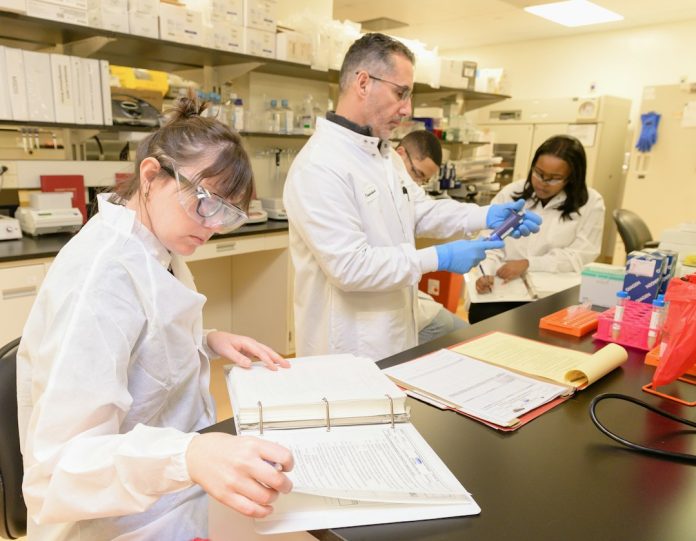
Featured image: scientists sharing knowledge during an mRNA vaccine production training session. Photo by the National Institute of Allergy and Infectious Diseases (NIAID), via Unsplash.